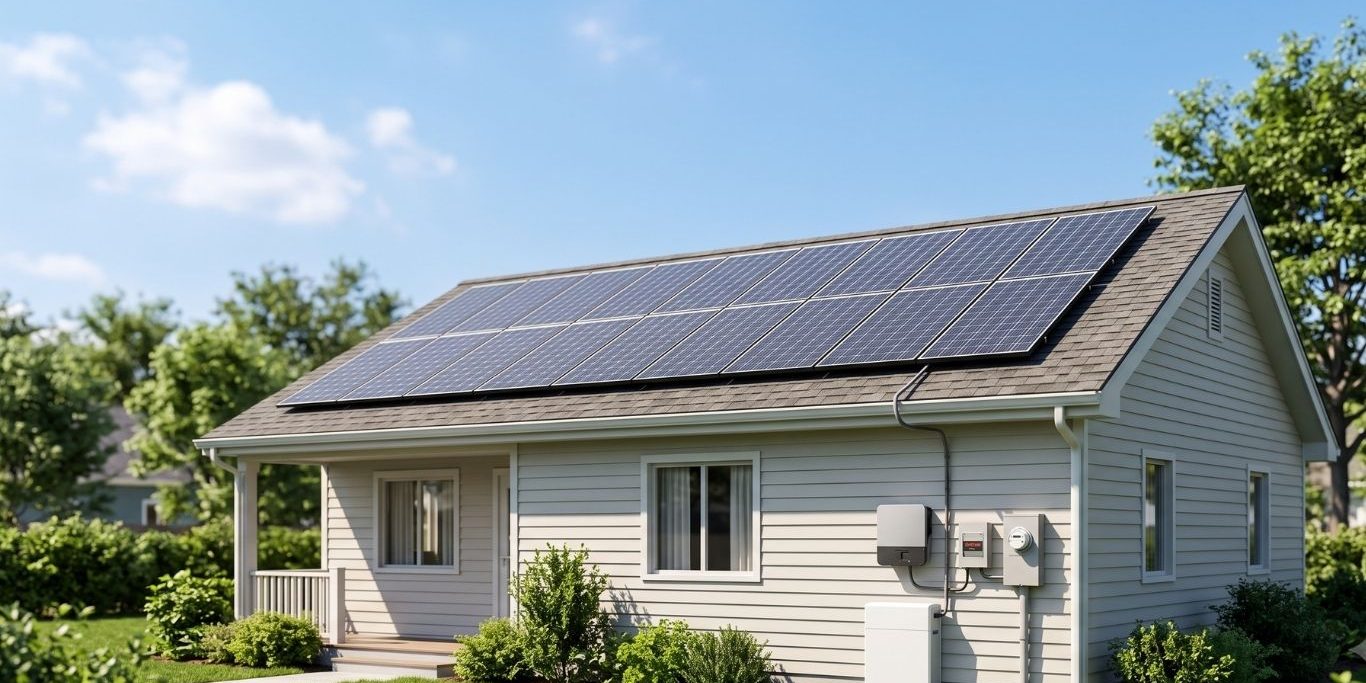
Spain’s abundant sunshine makes producing electricity at home an attractive option for many homeowners. Whether you live permanently in Spain or own a holiday property that you visit several times a year, installing solar panels can reduce the amount of electricity you need to purchase from the grid.
But generating solar electricity and making good use of it are not exactly the same thing. This is where solar self-consumption becomes important.
Solar self-consumption means using the electricity generated by your own photovoltaic installation directly in your home. Instead of purchasing all your electricity from an external supplier, part of your household demand is covered by the solar panels on your property.
Any electricity you cannot produce when you need it continues to come from the grid, while surplus solar production can, depending on the type of installation and contract, be exported to the electricity network or stored in a battery.
Understanding this relationship between generation, consumption and surplus electricity is essential if you want to determine whether solar self-consumption is a good investment for your home in Spain.
What is solar self-consumption?
Solar self-consumption is the process of producing renewable electricity and using that energy at the same property, or through an eligible collective self-consumption arrangement. In a typical residential installation, photovoltaic panels capture solar radiation and convert it into electricity. An inverter then converts that electricity into a form that can be used by your household appliances.
When your panels are producing electricity, your home uses this solar generation first. Imagine that your panels are generating 3 kW at midday while your home is consuming 2 kW. Those 2 kW can be supplied directly by your solar installation, reducing the amount of electricity you need to import from the grid. The remaining solar production becomes surplus electricity.
If, on the other hand, your home requires more electricity than the panels are producing, the difference is automatically supplied by the grid. This happens without you having to manually switch between solar power and grid electricity.
Solar panels do not usually mean disconnecting from the grid
A common misconception is that installing solar panels means becoming completely independent from the electricity network. Most residential self-consumption systems in Spain remain connected to the grid.
This provides an important advantage: electricity remains available when your solar panels cannot cover your household demand.
At night, for example, photovoltaic panels do not produce electricity. Production can also decrease significantly during periods of poor weather or when household demand exceeds the capacity of the installation.
In these situations, your home simply imports the additional electricity it needs from the grid. Going completely off-grid is possible in certain circumstances, but it normally requires sufficient battery capacity and careful system design. For most residential properties, combining solar self-consumption with a grid connection provides greater flexibility and security.
What happens to the solar electricity you do not use?
Your panels will not always generate exactly the amount of electricity your home needs. On a sunny afternoon, for example, your property may be consuming very little while the installation is producing close to its maximum capacity.
There are several ways to manage this surplus. One option is to export it to the electricity grid. Spain’s self-consumption framework allows eligible installations to use a simplified surplus compensation mechanism, under which exported electricity can generate an economic credit on the electricity bill.
For installations using this mechanism, the value assigned to surplus electricity depends on the applicable electricity contract. Importantly, under Spain’s regulated simplified compensation system, the economic value of the surplus cannot exceed the value of the electricity imported from the grid during the relevant billing period.
Another possibility is to store some of the surplus in a home battery for later use. Choosing the right option depends heavily on when your household consumes electricity.
Why your self-consumption rate matters
Installing more solar panels does not automatically mean achieving greater financial savings. What matters is how much of the electricity produced you can use effectively.
If your solar installation generates electricity when nobody is at home and most of that production is exported, the economics will be different from those of a household that consumes a large proportion of its solar electricity directly. This is why system sizing is so important. The objective should not necessarily be to install the maximum number of panels that fit on the roof. A well-designed system should take into account your annual consumption, daytime demand, seasonal usage and future energy needs.
You can also improve your self-consumption rate by moving flexible electricity use to the hours when your panels are generating. Running the washing machine or dishwasher during the day, heating water during solar production hours or charging an electric vehicle when solar generation is high can increase the amount of electricity you consume directly.
Do you need a solar battery?
A battery can increase your level of solar self-consumption, but it is not essential for every home:
- Without a battery, surplus electricity that is not immediately consumed can be exported to the grid if the installation is configured accordingly.
- With a battery, part of this surplus can instead be stored and used later.
For example, electricity generated during a sunny afternoon could be stored and then used in the evening after solar production has fallen. Whether this makes financial sense depends on your consumption profile, the cost of the battery, your electricity tariff and how your supplier compensates exported electricity.
A household with high evening consumption may benefit more from storage than one where most electricity is already consumed during daylight hours. For this reason, batteries should be assessed as part of the overall energy strategy rather than treated as an automatic requirement when installing solar panels.
Is solar self-consumption suitable for a holiday home?
This is particularly relevant for international property owners in Spain. A holiday home can have a very different consumption profile from a permanent residence. You may spend several months away from the property and then use significant amounts of electricity during summer because of air conditioning, pool pumps and other equipment.
Solar can still make sense, but the installation needs to reflect this pattern. A swimming pool, for example, may require filtration equipment during daylight hours even when the property is unoccupied. This can create a useful match between solar generation and consumption.
However, if the home uses almost no electricity for much of the year, installing a very large system simply because there is enough roof space may not provide the best return. The expected surplus, your supplier’s compensation conditions and any permanent loads at the property should therefore be considered before deciding on the size of the installation.
What about apartments and shared buildings?
Living in an apartment does not necessarily prevent you from benefiting from solar self-consumption. Spanish regulations allow collective self-consumption, meaning several consumers can share electricity generated by the same installation when the applicable requirements are met. This can make solar energy accessible to communities of property owners where individual rooftop installations would not be practical.
The generated electricity is allocated among participating consumers according to agreed distribution coefficients. Collective self-consumption requires more coordination than an individual installation because the participating consumers need to establish the relevant agreements and complete the necessary administrative procedures. However, it creates an important opportunity for people living in apartment buildings, residential developments and other shared properties.
How much can solar self-consumption reduce your electricity bill?
There is no single percentage that applies to every home. The savings depend on several factors, including:
- Your annual electricity consumption
- How much electricity you use during solar production hours
- The size and orientation of the installation
- Shading and local solar conditions
- Your electricity tariff
- How surplus electricity is managed
- Whether you have battery storage
It is also important to remember that solar panels do not necessarily eliminate your electricity bill. A grid-connected home will generally continue to have contractual and regulated costs, and electricity imported from the grid must still be paid for. The most useful calculation is therefore not simply how much electricity the panels can produce, but how the installation changes your total annual energy costs.
Is solar self-consumption legal in Spain?
Yes. Solar self-consumption is fully regulated in Spain. The country’s framework distinguishes between installations without surplus export and those that can export surplus electricity to the grid, as well as between individual and collective self-consumption.
The administrative procedure varies depending on factors such as the size, configuration and location of the installation. Some smaller residential installations benefit from simplified procedures, but requirements can also depend on the autonomous community and municipality where the property is located. For homeowners, this makes it important to work with an installer or energy specialist who can manage not only the technical installation but also its legalisation and registration.
What should you consider before installing solar panels?
The first step should be understanding your electricity consumption. Ideally, the system should be designed using actual consumption data rather than simply the size of the roof or an estimate based on the number of people living in the property. Hourly consumption data can reveal when your home uses the most electricity and how well those periods coincide with expected solar generation.
The roof itself must also be assessed. Orientation, inclination, available surface area and shading from neighbouring buildings, trees or other structures can all influence production. You should also think about future changes. If you are planning to install a heat pump, buy an electric vehicle or spend more time at the property, your future electricity consumption may be higher than it is today.
Designing the installation with these changes in mind can prevent it from becoming undersized as your household electrifies.
Solar self-consumption is about using energy more intelligently
The greatest advantage of solar self-consumption is not simply producing renewable electricity. It gives homeowners greater control over where their electricity comes from and encourages a more active approach to energy management.
Once solar panels are installed, the question changes from “How much electricity am I using?” to “When am I using it, and where is it coming from?”. Smart meters, energy monitoring systems, programmable appliances, EV chargers and home batteries can all help households adapt consumption to periods of high solar production.
The result can be a home that relies less on electricity purchased from the grid while making better use of the renewable energy generated on-site.
Conclusion
Solar self-consumption allows homeowners in Spain to generate renewable electricity and use it directly within their property, reducing the amount of energy they need to purchase from the grid. However, the success of an installation depends on much more than the number of solar panels on the roof. Your consumption pattern, system size, available solar resource, surplus compensation, battery requirements and future electricity needs all influence the final result.
For permanent residences, solar generation can cover part of everyday household demand. For holiday homes, the calculation requires additional attention because consumption may be highly seasonal. And for apartment owners, collective self-consumption can provide another route to accessing locally generated solar electricity. The best solar installation is therefore not necessarily the largest one. It is the one designed around how your property actually uses energy.
At Evergreen Eléctrica, we help homeowners and international property owners in Spain analyse their electricity consumption and determine whether solar self-consumption is right for their home. We can assess your consumption profile, solar requirements and electricity contract to design an energy solution adapted to the way you actually use your property.